
Selecting a Band-Saw
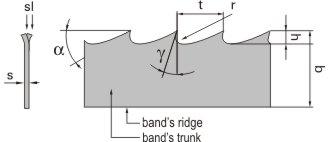
b - saw width
s - thickness
sl - value of the saw set on side
t - blade/saw pitch
h - height of the blade
Y - tool rake angle
a - clearance angle
r - gullet rounding radius
As a condition of correct sawing, the right saw has to be selected depending on the type of machine and material to be sawn.
Thickness of the saw should correspond to the machine technical specification, however, the thicker the saw, the more it is exposed to wear cracking. For hard wood thinner saws are recommended, for soft – thicker.
Width of the saw should be equal to the width of the guide pulleys adding the saw's gullet depth +(1-3) mm.
The pitch of the saw is expressed as a distance between two neighbouring teeth tips. Selecting proper pitch depends on both dimension and hardness of wood being sawn.
The tool rake angle is an angle included between the cutting edge's surface and he line perpendicular to the saw's back. An excessive tool rake angle to the feed applied causes saw's vibration, affecting the smoothness of the resulting surface. On the other hand, as the tool rake angle is insufficient, the saw end up being forced in the wood. The smaller the tool rake angle, the lower the cutting effectiveness.